
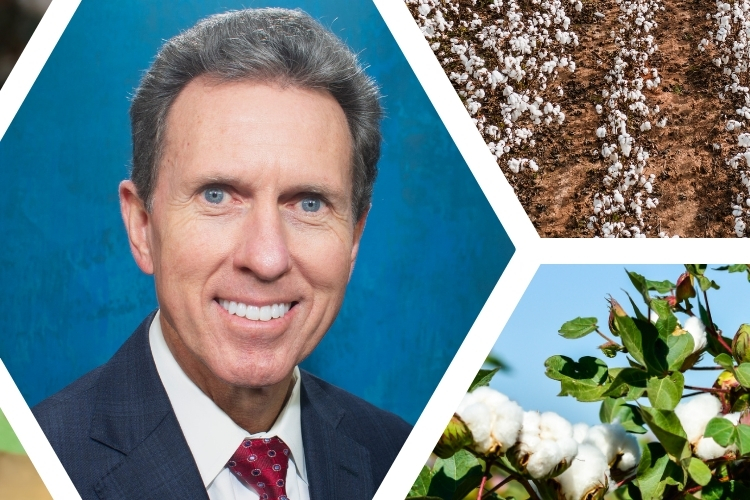
Gary Adams assumed the position of President and Chief Executive Officer of the National Cotton Council in 2015. He plays a key role in guiding the industry’s seven segments to reach consensus on critical policies affecting U.S. cotton, with the mission of helping all U.S. cotton industry segments compete effectively and profitably in global markets. Before moving into his current position, Gary served the Council for 13 years as the Vice President of Economic and Policy Analysis.
Gary currently represents the U.S. cotton industry as a member of USDA’s Agricultural Policy Advisory Committee. Prior to joining the Council, Gary was a Research Assistant Professor with the Food and Agricultural Policy Research Institute at the University of Missouri.
Gary has B.S. and M.A. degrees in Applied Mathematics from the University of Alabama and a Ph.D. in Agricultural Economics from the University of Missouri. Gary and his wife, Carol, have four children.
How did your educational experiences at the University of Alabama and the University of Missouri shape your leadership journey?
My studies at the University of Alabama in applied mathematics built a foundation for critical thinking and problem solving. It also instilled in me an appreciation that decisions need to be based on real data.
During my Masters program at Alabama, I was responsible for teaching two undergraduate math courses each semester. The regular lectures and Q&A with the students had a positive impact on my communication skills.
When I enrolled at the University of Missouri for my Ph.D. in Agricultural Economics, I had the great fortune of full-time employment at the Food and Agricultural Policy Research Institute (FAPRI) in the Department of Agricultural Economics. The real-world experience I received at FAPRI was invaluable to my position at the National Cotton Council.
A central aspect of my work at FAPRI was to collaborate with a team of economists to analyze commodity markets and the impacts that alternative policies would have on those markets. This collaboration involved my co-workers at Missouri as well as other universities. That experience helped me develop skills to build consensus and resolve differences among the team. My other responsibility at FAPRI was to effectively communicate the results of the analysis to stakeholders and other interested parties. Again, the communication skills developed during my time at the University of Missouri have been critical to my work for the U.S. cotton industry.
How do National Cotton Council of America’s (NCC) key priorities align with or benefit from the research, education, and Cooperative Extension mission of land grant universities?
 The National Cotton Council’s mission is to ensure the ability of all U.S. cotton industry segments to compete effectively and profitably in the raw cotton, oilseed and U.S.-manufactured product markets at home and abroad. I believe this very much aligns with the mission of land-grant universities. Research, education and outreach are foundational components of ensuring that the U.S. cotton industry can compete in highly integrated global fiber markets.
NCC’s top priority is shaping federal farm policy, including safety nets, risk‑management tools, and disaster assistance. Land‑grant universities—through their agricultural economics research and Extension economists—provide the data, modeling, and economic analysis that underpin these policy discussions.
Much of the ability of cotton producers to remain competitive and economically viable hinges on access to research and new technology. Land-grant universities conduct the majority of public research, whether that is related to pest pressures, disease control, precision agriculture or water management just to name a few.
Finally, I would add that producer outreach and education is another critical area where the goals of NCC and land-grant universities align. New research and technologies must be understood and adopted by producers in order to have a positive impact on their farming operations.
Would you share an example of how colleges of agriculture and natural resources at land-grant universities have helped NCC strengthen its impact and serve your stakeholders?
The NCC’s Cotton Foundation provides direct support to research projects at various land-grant universities addressing real-world challenges facing cotton producers. Currently, there are 14 projects being supported across the fields of entomology, agronomy, and disease/pathology. Specific challenges addressed by the projects include Integrated Pest Management, plant bug infestations, irrigation management, and evaluation of new cotton varieties, just to name a few.
In addition, NCC staff facilitate the annual meeting of the Southern Extension Weed Scientists, as well as attending the annual meeting of the Extension Entomologists.
As NCC works to ensure that all segments* of the U.S. cotton industry can compete effectively and profitably in domestic and international markets, what is a critical challenge where land-grant university research could make a meaningful difference? *Producers, ginners, warehousers, merchants, cottonseed, cooperatives, and manufacturers.
When I talk to producers today, their biggest concern is production costs. While the prices of inputs are beyond the reach of land-grant university research, university Extension can make a meaningful difference with new technologies, innovations and changes in production practices that result in lower costs per unit of production. I see this as especially critical for cotton since more than 85% of U.S. cotton is exported into a highly competitive global market.
Another area that I would encourage university research to focus on is assisting farming operations with the application of AI technology. Many cotton industry participants will not be able to keep up with this is a rapidly changing landscape so I see a tremendous opportunity for the development of practical applications that will save time and improve efficiency in managing a farming operation.
Drawing on your professional experience including your time as a research assistant professor in the University of Missouri’s Department of Agricultural Economics, what advice would you offer students pursuing majors aligned with NCC’s work and the broader cotton industry?
My advice would be to build strong analytical skills, embrace new technology, study agricultural policy and the political process, and stay abreast of the production challenges facing farmers. Throughout the college years, take advantage of internships at every opportunity. Internships can provide great experience and become a point of entry for a full-time position.
My other two pieces of advice are: 1) develop strong communication skills, both oral and written. It is critical to have knowledge, understanding, and solutions, but you have to be able to communicate those solutions to have an impact; 2) new technologies such as AI are powerful tools that should be used, but those tools should not be a substitute for a student’s own critical thinking.
How does Cooperative Extension deliver practical value to NCC’s stakeholders in local communities across the country?
The value of Cooperative Extension to NCC’s stakeholders is to transform university research into applicable field-ready solutions that help cotton producers improve productivity, reduce risk, and remain economically viable.
Cooperative Extension delivers land‑grant university research through field demonstrations, production guides, decision tools, and local field days. Cooperative Extension also delivers science‑based responses to emerging threats. A recent example is the coordinated effort by the University of Georgia, Auburn University and other southeast land-grant universities to address the cotton jassid pest, which rapidly emerged during the 2025 growing season.
When producers face these types of urgent challenges, such as pest outbreaks, herbicide resistance, or weather‑driven disease pressure, Extension specialists provide real‑time alerts, management recommendations, and localized risk assessments. This is especially valuable in cotton states where conditions change quickly, and growers need trusted guidance to protect their crop.
Looking ahead, where do you see the strongest opportunities to deepen collaboration and partnerships between NCC and land-grant universities?
In addition to areas that I’ve already mentioned, sustainability and traceability provide a great opportunity for more collaboration between NCC and land-grant universities. There is a growing call for more transparency in today’s complicated textile supply chains. The United States must be a leader in providing the data highlighting the environmental stewardship and responsible production practices of our cotton producers. Traceability through the supply chain is becoming a “must have” instead of a “nice to have.” We can do a better job of leveraging our data systems to provide the traceability that customers demand.
Another opportunity for collaboration involves opportunities to better tell the story of the hard science and rigorous research occurring within the land-grant system. We must address what appears to be a distrust and skepticism around real science.
The final area for collaboration involves working together to bring more students into the fields of study related to production agriculture. Future progress and innovation depend on the brightest minds working in these fields.
“Growing Together: Conversations with CEOs” showcases Presidents and CEOs of national agricultural associations, commodity groups, and other organizations and explores their powerful synergies with land-grant universities. Through conversations with leaders, this new interview series examines how organizations strengthened their impact in partnerships with Colleges of Agriculture and Natural Resources’ research, education, and Cooperative Extension. These interviews also highlight emerging opportunities to leverage collaboration, drive innovation, and serve all Americans.
Share this Post