
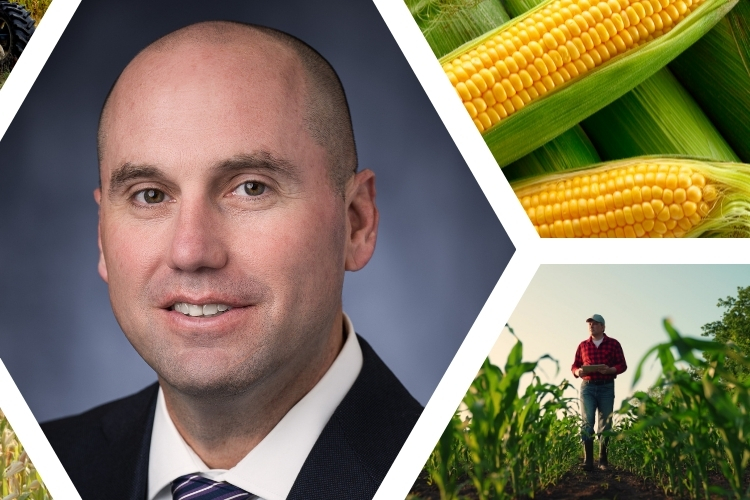
In February 2023, the National Corn Growers Association’s Board of Directors appointed Neil Caskey as NCGA’s CEO. In this role, Neil not only manages the organization’s day-to-day operations but also works in concert with the NCGA officer team and the board of directors to establish NCGA’s strategic goals and direction.
Prior to becoming CEO, Neil’s served as NCGA’s vice president of communications and industry relations for over four years. Prior to his time at NCGA, he spent more than a decade promoting agricultural issues as executive vice president at OBP Agency, a leading agriculture advertising and public relations firm. His professional background also includes work for the American Soybean Association and as a legislative aide for a U.S. member of Congress.
During his tenure at NCGA, Neil has been at the forefront of some of the organization’s top issues. Most recently, he played a leading role in challenging Mexico on its efforts to ban genetically modified corn. As a result of these efforts, the U.S. Trade Representative requested a panel formation under the U.S.-Mexico-Canada Agreement.
Neil holds a B.A. in political science from the University of Missouri-Columbia and a Master’s in Business Administration from Webster University.
How did your educational experience at the University of Missouri-Columbia impact your path to leadership?
My Mizzou experience shapes me to this day. I was a political science major. It was a puzzling choice of academic focus to my parents at the time, but public policy development has been a part of every single job I’ve held since graduating, from my time as a young Congressional staffer through my role today advocating for federal policies that best serve the American corn farmer. While at Mizzou, I was active in the leadership of my fraternity and I’m proud to say that service and affiliation with the university continues to this day, as member of our Chapter Advisory Board and father of two Mizzou students.
How do National Corn Growers Association’s (NCGA) key priorities align with land-grant universities’ research, education and/or Cooperative Extension programs?
 The alignment starts with a fundamental belief in the American corn farmer and support for public policy that enables them to make a good living on their land. To help deliver on that, we support federal investment in cutting-edge research initiatives that produce better tools, better seeds and stronger farmers. That’s why we’re advocating for the reauthorization of several key research priorities as part of the Farm Bill 2.0 deliberations, including the Ag Advanced Research and Development Authority, the Ag Genome to Phenome Initiative and the Farm and Ranch Stress Assistance Network.
How have colleges of agriculture and natural resources at land-grant universities helped NCGA strengthen its impact and serve your stakeholders?
We often lean into the objectivity of land-grant universities to inform our positions and validate our work, where appropriate. For example, our economic analysis team works directly with many of APLU’s members to gain critical insights that can’t be found anywhere else. Land-grants serve as a reliable pipeline of talent for NCGA leaders and staff. The extended national and state corn teams are loaded with products of the land-grant system.
As NCGA and its affiliated associations in 27 states work together to help protect and advance corn growers’ interests, what is one critical issue that land-grant university researchers and Cooperative Extension professionals can help address?
The biggest challenge facing the American corn farmers right now is demand creation. With that in mind, I’d encourage the system to invest in capabilities that enable it to help us solve that problem. Corn is an incredibly versatile plant that can be used to make over 4,000 products. Corn shows up in far more places than most people realize, well beyond food, feed and fuel. It’s used in personal care products, clothing and textiles, baby hygiene products and a wide variety of industrial materials. The bioeconomy is just getting started, and the land-grant system is positioned to help us accelerate its formation.
What advice would you give to college students interested in pursuing a professional career in agriculture or related industries?
If I was talking with a group of such students, I’d say thanks for considering a future in agriculture. And that we really, really need you, your skills and your passion working to solve our problems. We compete on a global stage, and American agriculture needs the best and brightest young talent there is working for us to keep us ahead of the competition.
What are high-impact opportunities to strengthen strategic collaboration and partnerships between NCGA and land-grant universities?
Help us create our very own SiliCORN Valley of innovation and opportunity for America’s corn farmers right here in America’s heartland. More specifically, help us create new corn-based solutions to consumer problems through the world-class network of research and development that is the American land-grant university system. That’s how we strengthen our partnership. And consider this an open invitation to do just that.
“Growing Together: Conversations with CEOs” showcases Presidents and CEOs of national agricultural associations, commodity groups, and other organizations and explores their powerful synergies with land-grant universities. Through conversations with leaders, this new interview series examines how organizations strengthened their impact in partnerships with Colleges of Agriculture and Natural Resources’ research, education, and Cooperative Extension. These interviews also highlight emerging opportunities to leverage collaboration, drive innovation, and serve all Americans.
Share this Post