
Why It Matters
Farmers and ranchers face rising costs, workforce challenges, unpredictable weather, and increasingly complex production decisions. Artificial intelligence (AI) and emerging technologies offer new tools to help address these pressures.
America’s public and land-grant universities are developing and applying AI, automation, robotics, drones, sensors and data-driven approaches to improve efficiency, strengthen decision-making and manage resources more effectively. Through research, education and Extension, these institutions are transforming technological advances into practical, cost-effective applications and solutions.
→ Key Takeaway
Land-grant universities advance AI and emerging technologies that help agricultural producers improve efficiency, reduce costs, address workforce challenges, and make informed decisions.
By the Numbers
Land-grant universities are putting emerging technologies to work to improve productivity, efficiency, and decision-making.
- “Woody breast,” a meat quality defect, accounts for more than $1 billion in direct and indirect costs annually across the U.S. poultry industry. University of Arkansas researchers are using hyperspectral imaging and machine learning to improve detection.
- Virginia wheat growers could gain up to 24 bushels per acre — translating to more than $100 per acre of wheat.
- Drone adoption across 7,800 acres represented by NC State Extension workshop participants is estimated to generate approximately $156,000 in annual savings or added value.
- Precision livestock tools developed in South Dakota reduced supplement use, saving $56 per head over seven months compared with bunk-fed controls.
- In tests, Penn State’s robotic apple blossom thinning system achieved 94% precision in detecting flower clusters and reduced chemical use by 67% compared with an air-blast sprayer and 46% compared with a boom sprayer, while achieving a similar fruit set per cluster.

A CEO’s Perspective
“With the goal of advancing agriculture globally, land grant universities’ research, education and Cooperative Extension programs continue to help state agriculture departments and the agriculture industry to gain knowledge on innovations and technology, educate on implementing new practices for efficiency, increased output and beyond, and provide key resources to U.S. farmers and ranchers to support the viability of American farms.”
In the Spotlight: Land-Grant Impacts
AI solutions for agriculture’s most pressing problems
University of Illinois Urbana-Champaign
The University of Illinois Urbana-Champaign created the AI for Future Agricultural Resilience, Management, and Sustainability (AIFARMS) National AI Institute for Agriculture to tackle challenges such as meeting global demand for food, reducing environmental impacts of farming, increasing affordability, and enhancing accessibility. The institute leverages dramatic advancements in AI, such as low-cost semi-autonomous systems that augment human efforts.
Funding Sources: Agriculture and Food Research Initiative (AFRI) and Hatch Capacity Funds
Detecting ‘Woody Breast’ Chicken Meat with Hyperspectral Imaging and Machine Learning
Arkansas Agricultural Experiment Station
“Woody breast” is a meat quality defect that causes chicken to be harder and chewier than normal chicken breast while still being safe to eat. When detected by poultry processors, the affected meat is diverted from whole-breast packaging for further processing. The loss in premium as a whole-muscle product accounts for yield loss as high as $200 million in Arkansas and more than $1 billion annually across the United States poultry industry. By combining machine learning with hyperspectral imaging, researchers improved the accuracy of woody breast detection.
Funding Sources: Agriculture and Food Research Initiative (AFRI) and State Appropriations
Using data to help wheat growers adapt to unpredictable weather
Virginia Tech
This research helps agricultural producers manage weather-related risks and make informed decisions with research-based information and practical tools. Farmers could see gains of up to 24 bushels per acre, translating to more than $100 per acre of wheat. Findings can be used on the Medius.RE Trial Data platform, which provides regional information on wheat planting dates, disease pressure, performance, and yield potential.
Funding Sources: Hatch Capacity Funds and Private Grants & Contracts
Flying High - Utilizing Drones on Your Farm
North Carolina State University
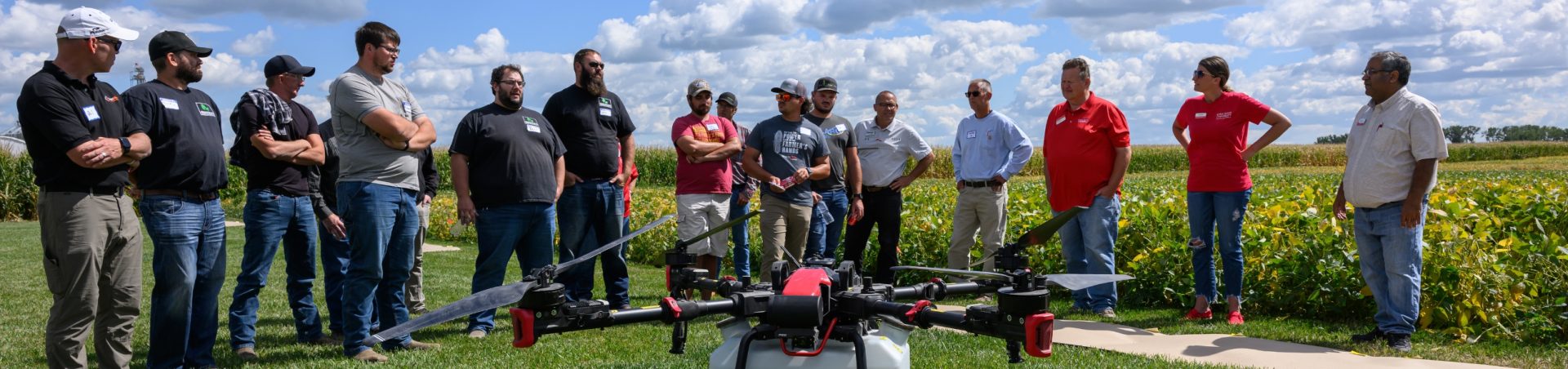
Through the “Flying High: Utilizing Drones on Your Farm” workshop, Extension agents connected producers with research-based expertise and industry professionals to help farmers understand drone technology, FAA regulations, and precision agriculture applications. Participants represented 7,800 acres of farmland, and adoption of drone technology on this acreage is estimated to generate approximately $156,000 in annual savings or added value.
Funding Sources: State Appropriations and Smith-Lever (3b&c) Capacity Funds
Precision on the prairie: Utilizing technology and data science to improve beef production on rangelands
South Dakota Agricultural Experiment Station
Precision on the Prairie developed a producer-ready data pipeline and AI/nutrition models that turn precision livestock sensor data into real-time rangeland management insights. Using in-pasture weights, GPS movement, and forage estimates, the team built tools to monitor growth, energy use, and supplementation needs for individual cattle. The model reduced supplement use and saved producers approximately $56 per head over seven months.
Funding Sources: Hatch Capacity Funds and McIntire-Stennis Capacity Funds
Development of a Robotic Apple Blossom Sprayer for Crop Thinning
Penn State University
To address agricultural labor shortages and reduce spending on chemical thinners, Penn State researchers are developing a robotic apple blossom thinner. In tests, flower cluster detection reached 94% precision. The robotic system saved 67% and 46% of chemicals compared with air-blast and boom sprayers, respectively, while achieving similar fruit set results.
Funding Sources: Hatch Capacity Funds and other
4-H Game of Drones: Preparing North Carolina’s Next-Generation STEM Workforce
North Carolina A&T University
Programs like the 4-H Game of Drones help secure North Carolina’s economic future by preparing youth for high-demand, high-wage STEM careers. By investing in digital and technical skills today, 4-H addresses workforce talent gaps in critical sectors including drones, coding, robotics, and automation. The program helps maintain the state's competitive edge while cultivating a capable workforce ready to drive future innovation and economic growth.
Primary Funding Source: 1890 Extension Capacity Funds
Development and validation of Ag-Automation Hazard and Risk Reduction Model (AAHRRRM)
University of Wisconsin
As farm labor shortages continue, producers are adopting increasingly automated equipment, including driverless tractors, field robots, and unmanned aerial vehicles. Researchers at UW-Madison are developing new risk assessment systems for autonomous equipment by building consensus among scientists, engineers, manufacturers, and regulators. The project is establishing standards, methods for measuring hazard exposure, and a new exposure-based database to improve agricultural safety.
Primary Funding Source: Hatch Capacity Funds
AES research leverages AI to speed up roadside weed detection
University of California
Researchers trained an AI tool using Google Street View imagery to identify noxious weeds, demonstrating a cost-effective approach for large-scale weed monitoring and management. This innovative scouting method could significantly improve roadside weed management while reducing costs. The technology could also be adapted for drone imagery and additional plant species, expanding its value for agricultural and natural resource management.
Primary Funding Source: Hatch Capacity Funds
Berry Picking Bots
Mississippi State University
Mississippi Agricultural & Forestry Experiment Station scientists are revolutionizing blackberry harvesting with an advanced robotic system powered by artificial intelligence and deep learning. The technology improves harvesting efficiency, reduces labor costs, preserves fruit quality, and enhances the profitability and long-term sustainability of blackberry production.
Funding Sources: USDA Competitive and Hatch Capacity Funds
Drones, AI Found to More Efficiently Measure the Health of Corn Plants
University of Missouri
A digital agriculture research team at the University of Missouri combined drone imagery with machine learning to provide farmers with more accurate information about corn crop health. This innovative application of emerging technology has the potential to improve the efficiency of agricultural systems while helping producers make more informed management decisions.
Funding Sources: Hatch Multistate Capacity Funds and Agriculture and Food Research Initiative (AFRI)
Technology-Based Extension Programming in Agriculture and Natural Resources
Tennessee State University
Tennessee State University Cooperative Extension programming in agriculture and natural resources helps advance the knowledge of new and beginning farmers while improving resilience to volatile markets, extreme weather, and pest pressures. The program also engages homeowners in sustainable lawn and garden practices that support fresh food access and promote healthy environments for future generations.
Primary Funding Source: 1890 Extension Capacity Funds
Impacts by Region
Land-grant universities develop, test, and apply rapidly evolving technologies to address real-world agricultural needs. By connecting scientific and practical expertise, they turn new approaches into useful tools for farmers, ranchers, and communities. This work ensures agricultural innovation responds to producers’ needs while strengthening the food system that Americans rely on every day.

Sample Social Media Posts
Land-grant universities develop, test, and apply emerging technologies to solve real-world agricultural challenges. Through [program name], [institution] helps farmers and ranchers harness innovation to [improve efficiency, profitability, resilience, etc.]: [program link]
Artificial intelligence, automation, drones, and data analytics are helping producers make more informed decisions and improve efficiency. Through programs like [program name], [institution] is turning emerging technologies into practical tools for agriculture: [program link]
[State] farmers face rising costs, labor shortages, and increasingly complex production decisions. Through Cooperative Extension, [institution] helps producers evaluate and adopt technologies that [improve productivity/profitability/farm resilience]: [program link]
Precision agriculture tools are helping farmers manage crops, livestock, and natural resources more effectively. At [institution], programs like [program name] combine technology and research to support informed decision-making on the farm: [program link]
Robotic systems, artificial intelligence, and automation are helping address workforce challenges across agriculture. [Institution] is developing practical solutions that help [state] producers remain competitive in a rapidly changing industry.
Connect with Us
AgIsAmerica
 (opens in a new tab)
 (opens in a new tab)
APLU Board on Agriculture Assembly
 (opens in a new tab)(opens in a new tab)
Tag us @AgIsAmerica or #AgIsAmerica.
Have a story for us to share? Email Kim at agcomms@aplu.org.
Holidays
MONTHS
National Apple Month, #NationalAppleMonth
National Hispanic Heritage Month, #HispanicHeritageMonth (September 15 – October 15)
National Pasta Month, #NationalPastaMonth
National Pizza Month, #NationalPizzaMonth
National Pork Month, #NationalPorkMonth
National Sausage Month, #NationalSausageMonth
National Seafood Month, #NationalSeafoodMonth
Vegetarian Month, #VegetarianMonth
WEEKS
October 4-10: National Fire Prevention Week, #FirePreventionWeek
October 4-10: National 4-H Week, #4HBeyondReady
October 18-24: National Veterinary Technician Week, #NVTW
DAYS
October 1: International Coffee Day, #InternationalCoffeeDay
October 1: World Vegetarian Day, #WorldVegetarianDay
October 5: World Teachers' Day, #WorldTeacherDay
October 5: World Habitat Day, #WorldHabitatDay
October 6: National Taco Day, #NationalTacoDay
October 9: World Egg Day, #WorldEggDay
October 12: National Farmer’s Day, #NationalFarmersDay
October 12: Indigenous Peoples’ Day, #IndigenousPeoplesDay
October 15: International Day of Rural Women, #RuralWomen
October 16: World Food Day, #WorldFoodDay
October 20: Anniversary of Equity in Educational Land-Grant Status Act of 1994
October 21: National Apple Day, #NationalAppleDay
October 22: National Nut Day, #NationalNutDay
October 24: National Food Day, #NationalFood Day
October 26: National Pumpkin Day, #NationalPumpkinDay
October 28: National Chocolate Day, #NationalChocolateDay