
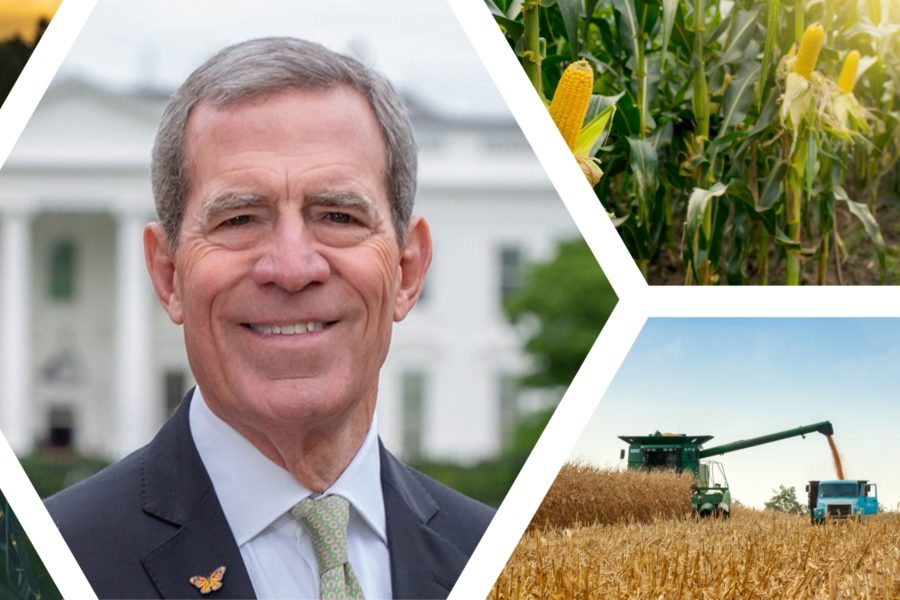
John Bode is President & CEO of the Corn Refiners Association, the trade association representing the corn milling industry.
John was chosen by his peers as the chair of the Agricultural Policy Advisory Committee, leading a select group of senior ag community representatives to provide advice to the Administration on trade policy matters.
John has been involved in every significant change in federal food law since the 1981 Farm Bill and served in three Presidential appointments at the U.S. Department of Agriculture, including Assistant Secretary of Agriculture for Food and Consumer Services. Before joining the USDA in 1981, he was on the staff of the U.S. Senate Committee on Agriculture, Nutrition, and Forestry, and served on the staff of then-Governor of Oklahoma David L. Boren.
Born in Oklahoma City, John was educated at the United States Naval Academy and the University of Oklahoma, receiving his B.A. in 1977. He received his J.D. from George Mason University School of Law in 1983.
How did your experiences growing up around agriculture in western Oklahoma and as a student at the University of Oklahoma influence your path to leadership?
I was blessed to grow up around food and agriculture in western Oklahoma, where I participated in 4-H and FFA, worked in a grain elevator, and learned early about agriculture’s diversity and the importance of innovation. My mother was a consultant dietitian and occasionally slowed her work down by using me as her proofreader. Working with her helped me develop an appreciation for nutrition and the connections among agriculture, nutrition, and human health.
After time at the Naval Academy, I attended the University of Oklahoma, where I served as student body president and successfully sued the governor over a tuition increase. He hired me after that! The combination of these experiences taught me that success comes from working with others in diligent adherence to a sound strategic plan, lessons that continue to guide my career.

As CRA advances corn products to benefit people, the planet, and the economy, how do land-grant universities help drive innovation and strengthen your impact?
Land-grant universities help us tremendously almost every day by providing the rigorous research and expertise that informs our work.
Over the last two years alone, CRA has worked with Purdue University to analyze the benefits of integrated North American markets and the United States-Mexico-Canada Agreement for U.S. consumers, North Dakota State University to examine the importance of refined corn products to corn farmers, and the University of Illinois on innovation in the bioeconomy. Our annual Feeding the Economy report uses the IMPLAN economic model, which has deep roots in the land-grant system, particularly at the University of Minnesota.
These institutions are indispensable partners in helping us better understand our industry today while developing the innovations that can move food and agriculture forward.
With support from more than 30 food and agriculture trade associations, the Feeding the Economy report annually documents the tremendous economic benefits generated by the U.S. food and agriculture system. Why does CRA feel the Feeding the Economy report is important for American food and agriculture?
The economic importance of American food and agriculture is too often underestimated, and Feeding the Economy’s main role is to tell that story. By looking at the food and agriculture system comprehensively rather than in silos, the report helps demonstrate its economic importance while creating an opportunity to explain the system’s complexity, diversity, and reliance on innovation.
There is another benefit that is just as important: we are developing “muscle memory” within the agricultural policy community for working together. Bringing more than 30 food and agriculture organizations together around a common effort strengthens our ability to collaborate on the challenges and opportunities we share.
What do you see as the most promising opportunities for collaboration between the corn refining industry and land-grant universities?
The future of agriculture is fundamentally a story of technology and innovation, and land-grant universities are essential to developing the concepts, physical resources, and human talent needed to put innovation to work.
One particularly exciting opportunity is biomanufacturing, which has been identified as a key national security imperative and offers enormous potential for agriculture and the broader bioeconomy. Human nutrition is another rapidly changing field, as we learn more about the microbiome, hormonal responses to food, and the tremendous variability in individuals’ physiological responses to what they eat. In both areas, land-grant universities give us confidence that we can get the science right and begin with fact-based assessments of how best to solve problems.
If you could ask land-grant university researchers for help with one critical issue, what would it be and why?
First of all – keep it up! We need their continued leadership in advancing technologies like biomanufacturing and in rapidly evolving fields such as human nutrition.
Their contribution goes beyond developing new concepts. They help determine the physical resources needed to put those ideas into practice and educate the people who will continually improve them. Innovation succeeds because we have both good science and skilled people who know how to effectively employ it.
The CRA internship program provides college students with opportunities to interact professionally with government officials, corporate executives, and advocacy groups. What skills and experiences are most important to prepare students seeking careers in the food and agriculture sector?
I would emphasize three things that are important in food and agriculture, just as they are in any career: accountability, teamwork, and an introduction to calculated risk.
None of us get to make decisions with perfect information; the information we have is always partial, the environment may still be developing, and circumstances often change. So, we have to learn when to act and how to assess whether a risk is worth taking.
At CRA, our interns participate in meetings, are encouraged to share their thoughts, and see firsthand how people with different perspectives but aligned objectives work together to solve problems. Giving students exposure to that kind of real-world decision-making environment is one of the best ways we can prepare them for successful careers.
How can Cooperative Extension provide the most value to CRA’s stakeholders in communities across the U.S.?
Cooperative Extension plays a fundamental role in helping agricultural communities keep pace with technological advances. I experienced the value of that system personally through 4-H, where I began land judging before continuing into Vo-Ag in high school and ultimately competing on a team that finished second in the International Land Judging Contest.
Cooperative Extension already does a great job at the farm and at the table, and I believe it can better help people understand how products get from the farm to the table, including the enormous contribution of agricultural manufacturing. We have roughly two-and-a-half times as many Americans manufacturing agricultural products as automobiles.
Based on your extensive experience shaping federal food and agriculture policy, what are the most effective ways to build partnerships across government, industry, associations, and higher education institutions that address complex food and agriculture challenges?
We need to begin with a shared understanding of the facts, including how our food and agricultural economy works from the farm through processing and manufacturing to the grocery store and ultimately the consumer.
From there, addressing complex challenges requires innovation, sound science, and risk-based policymaking, but building consensus around those things has become more difficult in an environment where people often retreat into their own echo chambers. We have to be respectful and patient with different perspectives, look for opportunities to establish common ground, and recognize that organizations can disagree sharply about tactics without necessarily disagreeing about the ultimate goal.
“Growing Together: Conversations with CEOs” showcases Presidents and CEOs of national agricultural associations, commodity groups, and other organizations and explores their powerful synergies with land-grant universities. Through conversations with leaders, this new interview series examines how organizations strengthened their impact in partnerships with Colleges of Agriculture and Natural Resources’ research, education, and Cooperative Extension. These interviews also highlight emerging opportunities to leverage collaboration, drive innovation, and serve all Americans.
Share this Post