
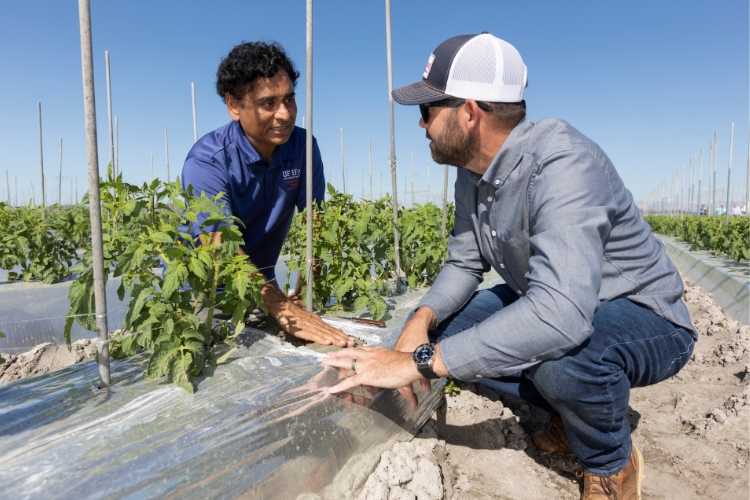
Across the nation, communities are navigating rapid change. From managing risk and planning farm transitions to expanding market awareness and accelerating innovation, land‑grant universities play a vital role in equipping producers, landowners, and policymakers with the knowledge they need to thrive amid uncertainty. Read on to learn how investing in land‑grant research and Extension means investing in America’s future.
Featured photo courtesy of Tyler Jones/UF/IFAS.
Securing Kansas’ agricultural future: a multi-state farm transition initiative
K-State Research and Extension
Primary Funding Sources: Smith-Lever (3b&c) Capacity Funds and County Funding.

Kansas agriculture faces a critical transition point. Within the next two decades, approximately 70% of U.S. farmland, representing billions of dollars in agricultural assets, is expected to transfer to new ownership. In Kansas, 65% of primary farm operators are age 55 or older, creating an urgent need for structured succession planning. In partnership with the University of Nebraska-Lincoln and Purdue Extension, K-State Extension delivered an educational series that brought farm transition expertise directly to Kansas families.
Building economic resilience by expanding forest landowners’ market awareness
Mississippi State University Extension Service
Primary Funding Source: Smith-Lever (3b&c) Capacity Funds.

Through accessible, localized forest economics education, Mississippi State University Extension’s comprehensive forest economics outreach program increased knowledge, reduced financial risks, and strengthened decision-making for nearly 2,000 stakeholders, generating broader economic and community benefits for Mississippi’s forest-dependent regions.
Helping farmers navigate global trade challenges
Virginia Agricultural Experiment Station
Primary Funding Source: Hatch Multistate Capacity Fund.

As the U.S. develops new trade policies, this work helps leaders make better decisions providing timely, data-driven evidence of potential costs and benefits that can lead to stronger trade deals and better outcomes for our farmers.
Researcher “speed-breeds” small grain varieties to boost crop production in Alaska
University of Alaska Fairbanks Cooperative Extension Service
Primary Funding Source: Hatch Capacity Funds.

A University of Alaska Fairbanks researcher is using a “speed-breeding” process to accelerate the development of suitable varieties of small grain crops, which can improve Alaska’s food production, promote economic development, and strengthen Alaska’s food system.
Share this Post