
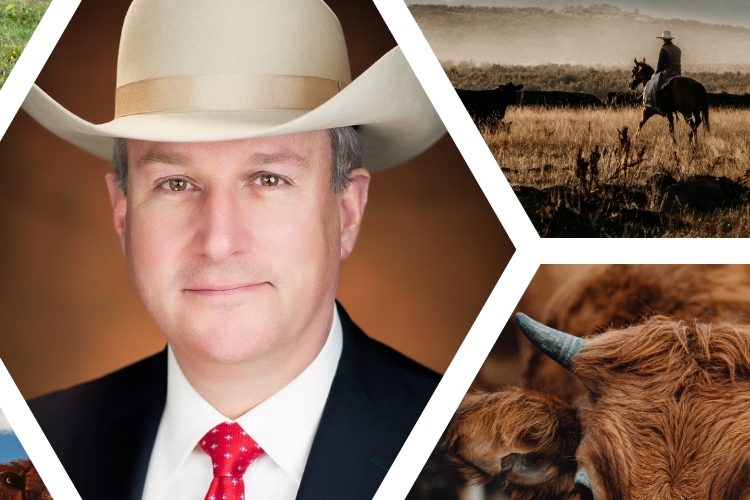
Colin Woodall is the Chief Executive Officer of the National Cattlemen’s Beef Association and leads the country’s oldest and largest national trade association for cattle producers in being the trusted voice and definitive leader of the beef industry.
Originally from Big Spring, Texas, Colin graduated from Texas A&M and then worked as a grain elevator manager and merchandiser for Cargill at several locations in western Kansas and the Oklahoma panhandle. After venturing to Washington, Colin took a job with U.S. Senator John Cornyn from Texas. He has been with NCBA since 2004 and served as the association’s Chief Lobbyist in Washington, D.C., for a decade. He is a founding member of the Government Relations Leadership Forum, a life member of the Houston Livestock Show and Rodeo, member of the Texas Aggie Corps of Cadets Association, the Agribusiness Club of Washington, D.C., the Washington Agricultural Roundtable, and is a past Chairman of the Board of Directors for the Agriculture Council of America. He also volunteers as a junior commercial steer show judge at the San Antonio Livestock Exposition.
How did your educational experience at Texas A&M impact your path to leadership?
Texas A&M shaped my leadership path long before I ever stepped on campus. Through 4-H and Texas A&M AgriLife Extension, I gained early exposure to agriculture, leadership, and public speaking. As a student, I experienced all components of the land-grant mission as envisioned by the Morrill Act of 1862. My time in the Texas Aggie Corps of Cadets instilled discipline, accountability, and a commitment to service, while my Agricultural Systems Management degree grounded me in the technical side of the industry. The leadership development and values-based education I gained at A&M set the foundation for my entire career. I can say confidently that I am where I am today because of my Texas A&M experience.
How do National Cattlemen’s Beef Association’s (NCBA) key priorities align with or benefit from land-grant universities’ research, education, and/or Cooperative Extension programs?
 NCBA’s priorities are determined by our grassroots members through robust discussion and debate, ensuring we always focus on the most pressing issues facing cattle producers. On many of these issues, land-grant universities provide invaluable research and expertise. Whether it’s animal health, sustainability, nutrition, or cattle markets, our policy positions are often informed by land‑grant research and economic analysis. For example, economists at land‑grant institutions have provided critical insights into market dynamics, helping us navigate periods of volatility and make stronger policy decisions. On emerging threats like the New World Screwworm, land‑grant researchers are pursuing new solutions while Cooperative Extension educates producers on detection and response.
How have colleges of agriculture and natural resources at land-grant universities helped NCBA strengthen its impact?
As a contractor to the national Beef Checkoff, NCBA has partnered with land‑grant universities on research ranging from nutrition and sustainability to food safety and new product development. Land‑grant institutions play a central role in the National Beef Quality Audit, conducted every five years, and their work has led to meaningful improvements in beef quality and safety. Checkoff-funded research at land‑grant universities even helped develop the flat iron steak, a strong example of how muscle profiling research can create new value for producers and new options for consumers. These partnerships have strengthened food safety, improved production efficiency, and ensured the U.S. continues producing the highest‑quality beef in the world.
As NCBA works to serve cattle farmers and ranchers, what is one critical issue that land-grant university researchers and Cooperative Extension professionals can help address?
Land‑grant universities are leading important work on the future of cattle and beef production, including enhanced land management and improved cattle efficiency. These efforts will help producers do more with less in a resource‑constrained world. Right now, however, the most urgent challenge is finding new ways to combat the New World Screwworm. Land‑grant researchers are essential partners in developing innovative control methods, and Cooperative Extension plays a critical role in educating producers about prevention and detection. Longer term, continued research on climate resilience and resource management will be essential for sustaining the beef industry.
What advice would you give to today’s college students?
It may not be the advice students want to hear, but take a technical writing class. Strong writing skills are increasingly rare, yet they remain essential for professional success. Whether drafting articles, briefing papers, or formal letters, the ability to communicate clearly sets candidates apart. The number of errors I see on resumes is alarming and avoidable. Beyond writing skills, students should pursue internships and hands‑on experiences. These opportunities help build real‑world skills, reveal strengths, and set students apart in a competitive field.
What are strong opportunities for increased collaboration and partnerships between NCBA and land-grant universities?
NCBA continues to seek land grant partnerships in food safety, new product development, nutrition, and sustainability research. We are also strongly invested in supporting the next generation of researchers and helping them connect with the cattle and beef industry. Our growing student membership and collaboration with collegiate cattlemen’s and cattlewomen’s chapters at land‑grant universities highlight our commitment to developing future leaders. Additionally, we offer summer, fall, and spring internships in both our Denver and Washington, D.C. offices for students interested in learning more about NCBA and the beef industry.
“Growing Together: Conversations with CEOs” showcases Presidents and CEOs of national agricultural associations, commodity groups, and other organizations and explores their powerful synergies with land-grant universities. Through conversations with leaders, this new interview series examines how organizations strengthened their impact in partnerships with Colleges of Agriculture and Natural Resources’ research, education, and Cooperative Extension. These interviews also highlight emerging opportunities to leverage collaboration, drive innovation, and serve all Americans.
Share this Post