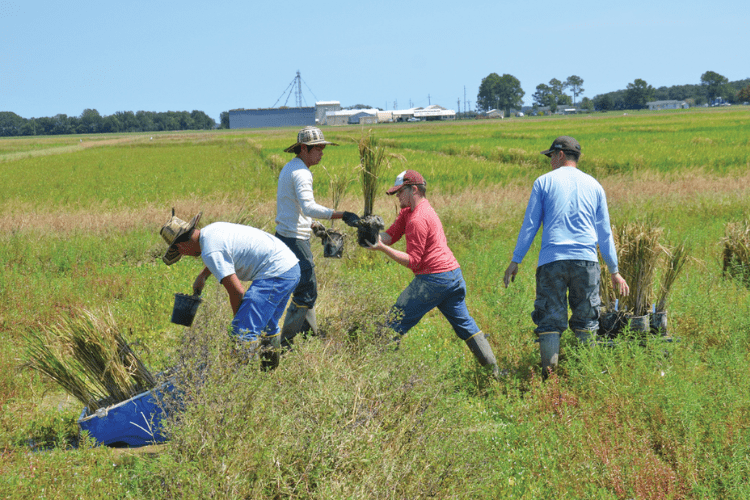
America’s land-grant universities strengthen the nation through a powerful and unique combination of research, education, and Cooperative Extension. These universities create new discoveries, educate the future workforce, and deliver practical solutions to communities across the United States. They are on the forefront of protecting our nation’s farms, supporting rural economies, improving public health, and ensuring that everyone has access to safe, nutritious, and affordable food.
RESEARCH
Scientists at land-grant universities are protecting our nation’s farms and food supply as they tackle some of the nation’s most pressing agricultural challenges. For example, they develop resilient crops, improve livestock health, strengthen food safety, and protect water resources. Their innovations and use of advanced technologies help farmers and ranchers stay productive and keep our food supply secure and resilient.
EDUCATION
At this time when our nation needs more skilled professionals in the food, agriculture, renewable natural resources, and environmental sectors (see below), education remains a core land-grant mission. By equipping students with critical thinking and technical skills as well as hands-on experience, land-grant educators prepare the next generation of farmers, ranchers, veterinarians, scientists, Extension professionals, and community leaders. They ensure that the nation will have a skilled workforce to address future challenges and keep America moving forward.
New USDA Study Projects Strong Job Opportunities in Food, Agriculture, Renewable Natural Resources, and Environmental Sectors
A new United States Department of Agriculture-funded study undertaken by Purdue University projects that employment opportunities will remain strong for new college graduates with interest and expertise in the food, agriculture, renewable natural resources, and environmental sectors (FARNRE). The report forecasts an average of over 104,00 FARNRE job openings annually between 2025 – 2030 for individuals with college degrees. USDA’s National Institute of Food and Agriculture supported the research.
Public agricultural schools exist in every U.S. state, territory, and the District of Columbia, forming a robust network through the Land-grant University system that collectively offers unparalleled educational opportunities. The system was established by landmark legislation in 1862, 1890, and 1994 and includes state flagship institutions, Historically Black Colleges and Universities, and tribal colleges. Land-grant universities are uniquely positioned and prepared to collaborate closely with USDA NIFA to attract, educate, and graduate the skilled professionals needed to meet the demands of tomorrow’s workforce, ensuring the U.S. remains a global leader in agricultural innovation and sustainability.
COOPERATIVE EXTENSION
Extension educators translate and disseminate university-generated research so that people and communities can rapidly apply practical tools and vital knowledge. Through its local presence and direct engagement with farmers, ranchers, foresters, and small business owners, they provide practical guidance to help effectively manage local and regional challenges. Serving every one of the country’s over 3,000 counties and parishes, Extension benefits people throughout the entire country.
LAND-GRANT IMPACTS EXAMPLES
Land-grant university research, outreach support beef production
The United States is the world’s top producer of beef, contributing to about 20% of the world’s production. In 2023, the U.S. beef industry had an estimated value of $102 billion. Land-grant universities are supporting the beef industry through research, Extension and education, ensuring producers remain economically viable and are able to safely meet changing market demands.
Projects funded by Hatch, Smith-Lever, USDA Competitive.
Protecting valuable water resources
Water resources that sustain agriculture and communities continue to face critical challenges. Land-grant universities are working to discover new ways to increase water use efficiency, reduce water use and protect water quality.
Projects funded by Hatch, Smith-Lever.
Land-grant researchers and Extension educators protect essential pollinators
Pollinators play a critical role in the world’s ecosystems, facilitating the reproduction of flowering plants and ensuring the production of many crops. But many pollinator populations are declining or at risk due to habitat loss, pesticide use and changing environmental conditions. Researchers and Extension educators at land-grant universities across the United States are finding ways to protect pollinators.
Projects funded by Hatch, Hatch Multistate, Smith-Lever, USDA Capacity-Extension.
Extension programs help producers, communities manage pests sustainably
Agricultural land and natural ecosystems face growing threats from invasive and noxious grasses and weeds, feral animals, pests and diseases that impair ecosystem services and agricultural productivity. Chemical pesticides can pose human and environmental health risks. Extension educators at land-grant universities help agricultural producers and communities develop and implement pest management strategies that are cost-effective but also minimize risks.
Projects funded by Hatch, McIntire-Stennis, Smith-Lever.
Advancing food security through sustainable livestock and crop innovations
Research at 1890 land-grant universities addresses critical challenges in animal and plant production. Collectively, these projects support sustainable food systems and food security by improving livestock and crop health, reducing reliance on agrochemicals and increasing production efficiency.
Projects funded by Evans-Allen, USDA Capacity-Extension.
Developing new farmers, new products and new markets to boost agriculture sector
Many communities across the United States are seeing a decline in the agricultural workforce as experienced farmers retire. This issue has been exacerbated by national declines in new and beginning farmers. Land-grant universities are working to recruit and train new farmers, address their challenges and find ways to help them to thrive, including new crops and new marketing opportunities. This work protects farmers’ bottom lines, helps strengthen economies and meet the growing demand for fresh, locally sourced foods.
Projects funded by Hatch, Hatch Multistate, Smith-Lever, USDA Capacity–Extension.
Understanding and identifying solutions for weather impacts on agriculture
Drought, severe weather and wildfires can have significant economic impacts on agriculture. Research and educational programming by land-grant universities helps us understand these effects and strengthen resilience.
Projects funded by Hatch, Hatch Multistate, Smith-Lever, USDA Competitive, USDA Capacity–Research.
Food industry worker training reduces foodborne illness and enhances workforce development
Foodborne illnesses are a common and costly, yet preventable, public health issue. Training workers in the food industry on food safety issues is critical to public health as well as workforce development. Land-grant universities across the country continue to find innovative and effective methods to train workers on foodborne illness, how to prevent it and how to train other employees about the latest food safety issues.
Projects funded by Smith-Lever, USDA Capacity–Extension.
Extension programs drive economic growth and community vitality
Especially in rural areas, business owners, local leaders and others can have trouble finding support, information and resources. Across the nation, Extension programs are helping boost local economies and build vibrant communities.
Projects funded by Smith-Lever, USDA Capacity–Extension, USDA Competitive.
Each land-grant university has its own powerful stories of people making a difference—researchers advancing discoveries that address real-world challenges, educators preparing students for productive careers, and Extension professionals working side by side with farmers, families, and communities to solve their local problems. Together, these efforts form a national network that translates knowledge and innovation into action and impact. Collectively, land-grant universities are accelerating discoveries and delivering solutions to create a more resilient, prosperous, sustainable, and secure future for all.
SOCIAL MEDIA
SAMPLE POSTS
RESEARCH
From [precision agriculture and AI] to [fortifying food security], @UNIVERSITY is driving research that transforms lives. Explore our latest advancements: LINK #LandGrantUniversities
EDUCATION
Through innovative education programs, @COLLEGE equips students with the skills to tackle today's challenges and lead tomorrow's solutions. Learn more about our programs: LINK #LandGrantUniversities
EXTENSION
.@EXTENSION programs at @UNIVERSITY connect cutting-edge science with local communities, empowering individuals and solving real-world problems. See how we're making a difference: LINK #LandGrantUniversities
Looking for pre-made stories to feature? Check out:
- Land-grant Impacts
Scroll down to "View by Institution" and click your university's name. Only institutions who submitted impacts to the National Impacts Database in 2024 are listed. This page features research and Extension impacts. - Multistate Research Funds Impacts
Scroll down to "Filter by Institution" on the sidebar and click your university's name. This page features research impacts.
Feel free to reach out to us with specific posts that you would like @AgIsAmerica to share. Please email your request to Kim Scotto at agcomms@aplu.org or use #AgIsAmerica.
HASHTAGS AND HANDLES
HASHTAGS
#LandGrantUniversities
#AgIsAmerica
HANDLES
|
Ag is America |
@AgIsAmerica |
|
APLU Ag |
@APLU_Ag |
|
USDA |
@USDA |
|
USDA National Institute of Food & Ag |
@USDA_NIFA |
|
APLU |
@APLU_News |
CALENDAR
JANUARY HOLIDAYS
MONTHS
National Soup Month, #NationalSoupMonth
WEEKS
January 20-23: International Hoof Care Week, #InternationalHoofCareWeek
January 25 - February 1: National Meat Week, #MeatWeek
DAYS
January 5: National Bird Day, #NationalBirdDay
January 6: National Bean Day, #NationalBeanDay
January 9: National Apricot Day, #NationalApricotDay
January 11: National Milk Day, #NationalMilkDay
January 19: Martin Luther King Jr Day, #MLKDay
January 23: National Pie Day, #NationalPieDay
January 24: National Peanut Butter Day, #PeanutButterDay
Source: JANUARY - National Day Calendar